
The Sudo-Intellectual Strategic Planning Framework
A complex adaptive systems approach to planning for social change
Work in Progress by Logan Jensen, MPA Candidate, MIIS
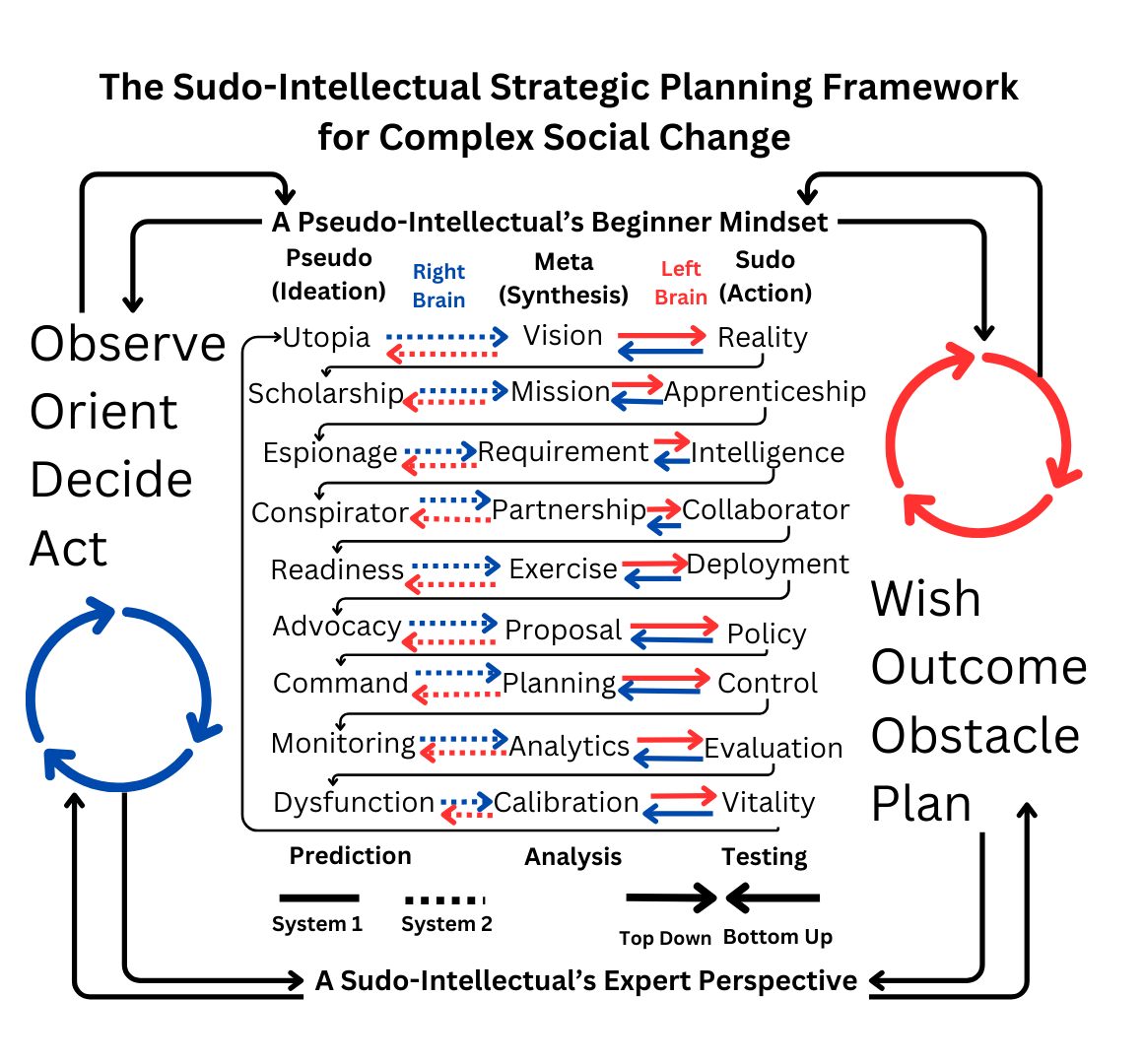
Introduction: Bridging Thought and Action
The Sudo-Intellectual Strategic Planning Framework represents a sophisticated approach to social change that elegantly bridges the gap between abstract ideation and concrete implementation. This framework acknowledges a fundamental challenge in effecting meaningful change: the difficulty of translating lofty ideals and critical perspectives into tangible, sustainable outcomes. By structuring the journey from conception to execution as a series of deliberate cognitive phases and thematic progressions, it offers a comprehensive roadmap for individuals and organizations seeking to transform society.
At its core, the framework recognizes that social change requires a dynamic interplay between different modes of thinking and acting. The name itself contains a clever wordplay: "Pseudo-Intellectual" suggests the initial phase of exploratory, critical thinking that might appear superficial but serves as essential groundwork, while "Sudo-Intellectual" evokes both the computer command for administrative execution ("sudo" in Unix/Linux) and the implementation of intellectual ideas in the real world with elevate permissions for action. The framework is designed as a ‘do nothing box’ where attempts to implement a ‘sudo-solution’ using elevated privileges and the planning to prepare or them make using these outside solutions less necessary.
The Three Cognitive Phases: A Journey Across Brain Functions
The cognitive phases at the beginner level constitute the preconditions of generating wisdom and intution over time. Cycling between having an idea, synthesizing it with data from the real world, and taking action with respect generates a wealth of experience and outcome data that that is highly useful for coming to making better and better predicitions about how complex systems work over time.
When this experience is subjected to the expert-level process of making predictions based on mental models, analyzing the data related to the prediction, and testing the results against the prediction experience becomes complex system wisdom and increasingly accurate predicitions, although never perfect of complex behaviour.
Many people start their careers in the beginner phase and slowly and implicitly develop their capabilities over time until they achieve expert status. Here at Sudo-Intellectual we reject that linear and segmented approach. Rather, we encourage completing a full loop as early and often as possible such that one is constantly oscillating between a beginner mindset and bias for action, and the expert perspective and its wise contemplation.
We recognize that hard and fast predictions are rarely correct and the ones that are are quickly out of date almost as soon as they’re made, but we place the emphasis on the sudo-scientific method of obsrving the world, coming up with ideas of how it works that synthesisze diverse disciplines, make testable predictions, act in accordance with them to gather data, analyze what was right and what was wrong, and update your knowleddge to reflect the results of an informal, micro experiment. It doesn’t take very many of such experiemnts to develop expert level intution, so here’s how you can start running them.
Pseudo (Ideation) - The Right-Brain Domain
The Pseudo phase harnesses the power of imagination, creativity, and holistic thinking. Here, beginners observe the world through the lens of possibility, engaging with utopian thinking, scholarship, and the discovery of hidden system dynamics without immediate concern for practicality. This observation stage establishes the foundation for understanding existing structures and imagining alternatives.
Expert practitioners in this phase leverage their accumulated knowledge to make predictions about system behavior. They create mental models that synthesize complex interdependencies and identify potential leverage points for change. The expert's predictive capacity doesn't seek perfect foresight but rather establishes hypotheses that can be tested and refined through subsequent phases.
Both perspectives contribute to the sudo-scientific method by establishing a rich foundation of observations and hypotheses about how complex systems operate. This ideation phase mirrors the early stages of scientific inquiry where phenomena are observed and initial questions are formulated, though with greater emphasis on creative possibility-thinking.
Meta (Synthesis) - The Corpus Callosum
The Meta phase serves as a cognitive bridge where abstract concepts gain structure and direction. Beginners orient themselves by transforming utopian ideas into concrete visions, converting scholarly insights into defined missions, and organizing disparate observations into clear requirements. This orientation process creates the structured understanding needed before meaningful action can occur.
Experts approach this synthesis through rigorous analysis, systematically examining information to extract meaningful patterns and implications. They decompose complex problems, integrate insights across domains, and evaluate the validity of their predictive models. This analytical perspective balances creative ideation with practical constraints.
Within the sudo-scientific method, this phase parallels the development of testable hypotheses and experimental design. It transforms general observations into specific questions and approaches that can be effectively implemented and measured. The synthesis creates the crucial connection between creative insight and practical application.
Sudo (Action) - The Left-Brain Domain
The Sudo phase focuses on execution, governance, and the practical implementation of plans. Beginners act to bring their oriented ideas into reality, manifesting visions as observable outcomes, applying missions through apprenticeship, and converting requirements into actionable intelligence. This action-oriented approach emphasizes learning through direct engagement with complex challenges.
The expert perspective in this phase centers on testing predictions against real-world outcomes. Experts systematically evaluate results against expectations, identify discrepancies between models and reality, and establish feedback loops for continuous refinement. Their approach combines both top-down and bottom-up methods to gather empirical evidence about system responses.
This phase completes the sudo-scientific method cycle by gathering empirical data through implementation and measuring results against predictions. Just as a scientist collects experimental data to confirm or refute a hypothesis, change agents in the Sudo phase gather real-world feedback that informs future cycles of observation and prediction.
The Continuous Cycle of Growth
What distinguishes this framework is its emphasis on continuous cycling between phases and perspectives. The beginner's Observe-Orient-Decide-Act cycle (blue loop) and the expert's Wish-Outcome-Obstacle-Plan cycle (red loop) operate concurrently, with practitioners moving fluidly between them. Each iteration increases the accuracy of mental models while maintaining creative flexibility. By rejecting a purely linear progression from beginner to expert and instead embracing ongoing oscillation between these mindsets, practitioners develop both practical wisdom and theoretical understanding more rapidly than those fixed in a single perspective. This holistic approach creates a powerful foundation for developing the intuition needed to navigate complex social change.
The Cognitive Systems: The Underlying Mental Processes
At the foundation of the framework lie two fundamental cognitive modes derived from Daniel Kahneman's influential work:
System 1: Fast, Intuitive Thinking
The solid lines indicate System 1 thinking—rapid, automatic, emotional, and stereotypic. This system excels at pattern recognition, emotional processing, and intuitive responses. It dominates in the Sudo phase, where implementation requires a fast and intuitive focus on getting things done within what the right brain and system 2 thinking determined most likely to lead to sustainable and impactful social change. This phase acts top-down while collecting bottom-up information about the effects and impacts of actions
System 2: Slow, Analytical Thinking
The dashed lines indicate System 2 thinking—slow, effortful, logical, and calculating. This system handles complex computations, detailed analysis, and model-based reasoning. It prevails in the Pseudo phase, where imagination and critical thinking thrive on associative connections and holistic perception. This phase integrates wholes, develops thinking models and theories of change, and identifies impactful nudge strategies. This phase thinks bottom up, wit the knowledge that what it produces must translate to top-down action, even if its at the individual level.
Acting: The Bridge Between Systems
Between these two systems lies "Acting"—the fluid movement synthesis of intuitive and analytical modes that characterizes expert performance. This represents the developed capacity to know when to trust instinct and when to engage in deliberate reasoning—a form of meta-cognitive awareness that comes with deep experience in navigating change processes.
The Nine Thematic Progressions: From Abstract to Concrete
The framework's nine rows represent different domains through which change unfolds, each following a progression from abstract beginnings to applied outcomes:
Utopia → Vision → Reality: This primary progression captures the overarching journey from idealistic dreaming to practical implementation. It begins with imagining perfect worlds, translates these into strategic visions with clear goals, and culminates in tangible realities that, while imperfect, represent genuine improvement.
Scholarship → Mission → Apprenticeship: This progression covers the knowledge dimension, moving from theoretical understanding through purposeful direction to practical mastery. It recognizes that learning must eventually be applied and transmitted through mentorship and disciplined practice.
Espionage → Requirement → Intelligence: Here we see information gathering evolve into defined needs and ultimately actionable insights. The provocative term "espionage" suggests the need to look beyond official narratives and surface appearances to understand what's really happening within systems and among the people that make them up.
Conspirator → People → Collaborator: This progression tracks the social dimension of change, from initial alignment among dissenters to broad-based movements to structured cooperation. It acknowledges that change often begins among those willing to question and challenge before expanding to wider circles.
Readiness → Exercise → Deployment: This practical progression moves from preparedness through testing to decisive action. It emphasizes the importance of capacity building and rehearsal before full implementation.
Advocacy → Proposal → Policy: The governance progression shows how public persuasion can be channeled into formal proposals and eventually codified as rules and structures. It maps the path from raising awareness to establishing lasting change mechanisms.
Command → Process → Control: This administrative progression traces how directive energy becomes systematized into repeatable methods and eventually regulated for consistency. It addresses the organizational infrastructure needed to sustain change.
Monitoring → Analytics → Evaluation: The assessment progression emphasizes the importance of attention, measurement, and judgment in determining effectiveness. It ensures that change efforts remain accountable to their intended outcomes.
Dysfunction → Calibration → Vitality: This final progression acknowledges that change often begins with recognition of what's broken, requires ongoing adjustment, and aims ultimately for systemic health and resilience.
Embedded Feedback Loops: Strategic Guidance Systems
The framework incorporates two powerful feedback loops that guide the change process:
The OODA Loop: Tactical Adaptation
Derived from military strategy, the Observe-Orient-Decide-Act loop provides a tactical model for decision-making under pressure. Positioned on the left side of the diagram, it shows how change agents must continually gather information (Observe), make sense of it (Orient), determine responses (Decide), and implement them (Act).
The OODA loop connects primarily to the Pseudo and Planning phases, where observation and orientation occur, and extends into the Sudo phase for decision and action. Its cyclical nature emphasizes that social change is not linear but requires constant adaptation based on emerging information and outcomes.
The WOOP Loop: Psychological Planning
On the right side, the Wish-Outcome-Obstacle-Plan loop offers a psychological framework for translating desires into action. This loop acknowledges that change requires not just strategic thinking but also psychological preparation for action:
Wish: Identifying what you truly want to achieve
Outcome: Visualizing the specific benefits of success
Obstacle: Anticipating the barriers you'll encounter
Plan: Preparing specific responses to overcome those barriers
This loop spans all three cognitive phases, with wishes emerging in Pseudo thinking, outcomes and obstacles being explored in Planning, and plans being executed in the Sudo phase.
Cyclical Structure
The overall diagram is enclosed in a cycle, suggesting that the entire process is iterative. The "Beginner Mindset" at the top evolves into the "Expert Perspective" at the bottom, which then feeds back into renewed beginnings—acknowledging that true expertise often involves returning to fundamental questions with deeper understanding.

Practical Application: A Flexible Framework for Change
What makes this framework particularly valuable is its flexibility. Users can:
Enter at any point based on their current situation—whether they're starting with a vision, responding to a breakdown, or facing an immediate demand for action
Focus on specific rows that align with their primary domains of influence
Cycle through micro-loops within individual progressions before connecting to broader efforts
Move fluidly between cognitive phases as needed, rather than proceeding in strict linear fashion
This adaptability makes the framework applicable across diverse contexts—from grassroots activism to institutional reform, from technological innovation to cultural change initiatives.
Conclusion: Beyond the Diagram
The Sudo-Intellectual Strategic Planning Framework offers more than just a structural map for change processes. It provides a meta-cognitive tool that helps change agents develop greater awareness of their own thinking patterns and strategic approaches.
By explicitly connecting abstract ideation to concrete implementation through deliberate cognitive phases and thematic progressions, it addresses one of the most persistent challenges in social change work: the gap between critical thinking and effective action. It reminds us that meaningful change requires both visionary imagination and practical execution, both divergent exploration and focused implementation.
In a world where social challenges grow increasingly complex, such integrative frameworks become essential tools for those committed to creating sustainable positive change. The Sudo-Intellectual framework stands as a sophisticated contribution to this vital effort—bridging the worlds of thought and action in service of a better future.