
The pDissident Act and the pNSA (the p is silent)
Flipping the Script on the Privacy-Niks by grounding Privacy Protections in the Consent-Based Third Amendment Protection Against Quartering
Thought of and written by Logan Jensen, Sudo-Intellectual Candidate
Edited and Enhanced by Claude, Artificial General Intelligence Candidate
Protecting our Public, Private, and Secret Lives
Gabriel García Márquez, who is one of my favorite authors and who had significant influence developing my magical-realist approach to policy, once wrote, "Every man has three lives: a public life, a private life, and a secret life." Regarding the privacy of our data and our control over how private and public actors use it, we seem to have mixed all three lives and come away with nothing at all. Frameworks like GDPR stifle the use of private data in Europe, ostensibly to protect our private and secret lives, while in reality creating road blocks to making productive use of it. On the Other Hand, the Data Wild West permits data exploitation by private and public actors in the US and across the globe with relatively little scrutiny. With the level of privacy we already cede to use essential digital services, there are very few secrets that aren’t already known or at least predicted by someone somewhere as soon as someone thinks them up.
What if the next evolution in privacy didn't come from building higher and thicker walls around our data but from flipping the script on privacy entirely and focusing how to design the channels our data flows through and which lakes store it? In an age where the Patriot Act enables distinctly unpatriotic invasions of our digital lives, I propose the intentionally ironic Pseudo-Dissident Act as a framework for privacy protection and data utilization. The pseudo-governmental agency this act creates wouldn't merely resist invasive surveillance with privacy protection backstopped by the Fourth Amendment protection against searches and seizures, but transform our privacy paradigm by basing it on the consent-backed protection against quartering soldiers found in the nearly defunct Third Amendment.
Rather than biasing toward complete protection like GDPR or maximum personal data exploitation like the US, this framework would provide a third way of protecting privacy by flipping the script on what privacy and data protection are. This new script would, allow more overt and approved personal and private data access while ensuring transparency and control over personal data sharing preferences in a way that citizens benefit from its consensual utilization through mutually beneficial, consensual, and transparent process.
A Cautionary Tale About Privacy in George Orwell's 1984
In Orwell's 1984, privacy invasion is the backbone of totalitarian control. Winston Smith's world is defined by constant surveillance through telescreens, facial monitoring for "facecrime," and the weaponization of intimate personal information. His attempt to create privacy by writing in a diary is considered thoughtcrime. At the same time, his false sanctuary with Julia is revealed as a trap when a hidden telescreen exposes their rebellion. Perhaps most chilling is how the Party uses data against their citizens. Winston's neighbor is reported by his seven-year-old daughter for sleep-talking against Big Brother while Winston receives personalized torture based on surveillance data, using Winston's specific fear of rats against him in Room 101.
These fictional horrors parallel today's digital privacy debates with unsettling clarity. Just as the Party collected intimate knowledge to control Winston, modern data harvesters often gather our preferences, habits, and fears without receiving meaningful consent. This "false sanctuary" mirrors our illusion of private digital spaces that are constantly monitored. While we don't have children reporting parents to authorities, we have devices in our homes listening for keywords and algorithms analyzing our communications. The key difference is that in our world, this surveillance is primarily conducted by corporations rather than governments, although the line increasingly blurs as data is shared across sectors. Unlike Winston, we still have the opportunity to shape how our data is used, but only if we recognize the parallels before our digital panopticon becomes complete.
The Pseudo-Dissident Act: Constitutional Foundations for Digital Privacy
The "Pseudo-Dissident Act" is deliberately provocative in its naming, transforming the irony of the Patriot Act's unpatriotic surveillance into a framework that genuinely empowers citizens to own and control their data. This Act affirms a fundamental principle: individuals own the data they generate and should control its use on their terms. Unlike current regulations that either restrict data use (GDPR) or permit unchecked exploitation (US practices), the Dissident Act creates a legal basis for data "invaluation" – converting personal data from an exploited resource into a valuable asset under its owner’s control.
America's current privacy paradigm relies primarily on Fourth Amendment protections against "unreasonable searches and seizures," but this framework has proven inadequate in the digital age. Courts struggle to apply concepts like "reasonable expectation of privacy" to information shared with third parties, creating a constitutional blind spot that enables mass surveillance without meaningful consent. The stewards of our data have it, but promise not to use it without either a secret warrant from a secret court or a secret client willing to pay a secret price.
The Third Amendment—prohibiting the quartering of soldiers in private homes without owner consent—offers a surprisingly relevant alternative. Though rarely invoked, its core principle is powerful: The government cannot occupy private space without explicit permission. Applied to digital contexts, The Third Amendment’s "consent-first" approach recognizes personal data as an extension of the private domain and can only be be bought and sold according to the owner’s express consent. While no individual piece of data seems valuable enough, the total market for data is estimated at around $500 Billion, with very little of that ever making it back to the rightful owner of the brokered data.
The Pseudo-National Sensorship Agency (pNSA) would serve as the mechanism for implementing this vision, functioning as a the people’s data broker that connects the people's data with opportunities that benefit them. "Sensorship" plays on "censorship" but in this context means quite the opposite. Censorship is sensing, by whatever means, when your data has value and helping you capitalize on it. Through a single comprehensive preference interface, citizens could set their data-sharing parameters once instead of navigating endless website permissions and make a few tenths or hundreths of a percent every time their data is accessed. When a valuable opportunity arises outside of their allowed preferences– perhaps a medical researcher needs genetic information from people with specific characteristics – the pNSA would either automatically facilitate the exchange based on pre-established permissions or notify the user with options like: "Researcher offers $75 plus study results for your anonymized genetic markers. Accept/Decline/Negotiate?" to present a an opportunity to allow an exception with the details of who wants the data and why presented clearly and openly.
This isn't a radical departure from constitutional principles but their logical extension into the digital realm. By framing data access as a form of "digital quartering" requiring explicit permission and fair compensation, the Act creates a coherent legal basis for protecting personal information while enabling its valuable use. While it may be weird to imagine 18th century soldiers entering your quarters and eating all your data, the principal of stopping modern data brokers from doing so is at least holds prima facie. The framework creates a transparent, balanced ecosystem where data flows based on mutual value creation rather than extraction and recognizes that our founding document's protections must evolve to preserve liberty in contexts the Framers could never have imagined but would undoubtedly have sought to protect.
Proof of Concept in Estonia’s E-Government Framework
Estonia's journey toward digital governance emerged from necessity rather than luxury. Following a massive 2007 Russian cyberattack that crippled banks, media outlets, and government services, Estonia transformed crisis into opportunity by building a digital infrastructure designed for resilience, transparency, and citizen control. Today, this Baltic nation of just 1.3 million people offers a working proof-of-concept for robust digital citizenship that balances security with usability and privacy with functionality.
The lynchpin of Estonia's system is X-Road, a decentralized data exchange layer that enables secure communication between different information systems. Unlike traditional approaches that consolidate information in vulnerable central repositories, X-Road connects disparate databases while keeping data at its source. When a doctor needs medical records or a tax official requires income verification, they access this information directly through authenticated channels rather than duplicate databases. Every instance of data access is logged and visible to citizens in a way that creates accountability through transparency. This architecture demonstrates that efficient government services don't require either surrendering privacy or or centralizing control.
Estonia's digital identity system starkly contrasts America's fragmented approach. While U.S. citizens navigate a patchwork of state IDs and repurposed Social Security numbers (with Real ID adding complex e-epicycles rather than coherence), Estonians possess a unified digital identity with robust security features. Their ID cards contain encrypted certificates enabling legally binding digital signatures, secure authentication, and transparent access logs. This foundation of trust allows Estonians to vote online, bank securely, sign contracts digitally, and access medical services seamlessly—all while maintaining visibility into who accesses their information and why.
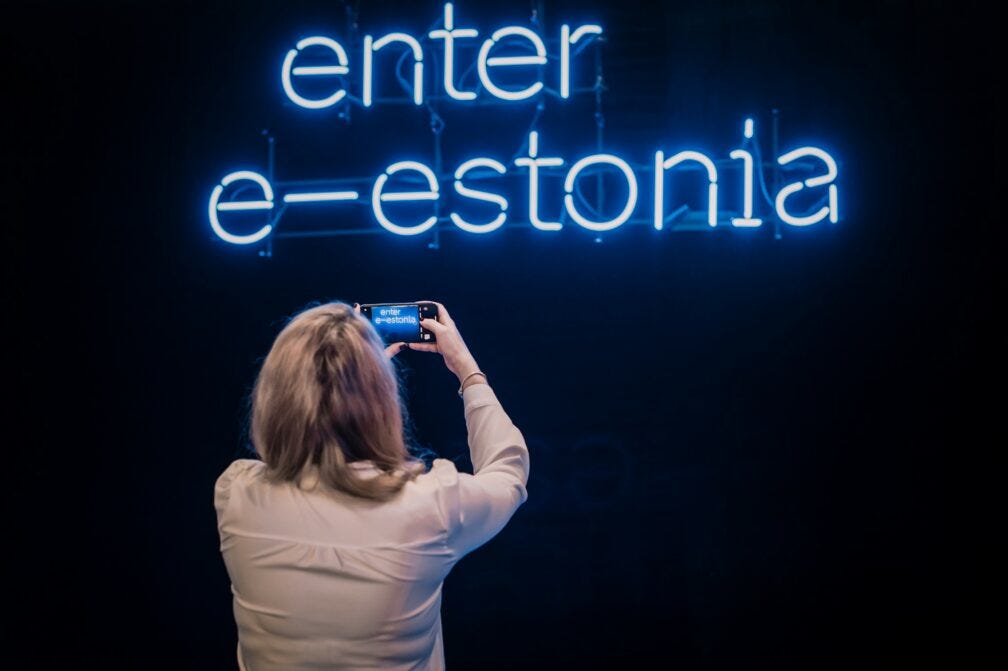
Perhaps Estonia's most transformative innovation is its "once-only" principle, which fundamentally reimagines the citizen-government relationship. Rather than requiring individuals to repeatedly provide the same information across agencies (with all the attendant inefficiency and error potential), Estonian citizens provide information once, which is then shared across systems with explicit consent. When registering a business, for example, an entrepreneur's information automatically populates forms across tax authorities, business registries, and social security systems—dramatically reducing bureaucratic friction while maintaining consent and transparency.
Estonia didn’t build its system by ignoring privacy concerns but by addressing them directly through architectural choices. By designing for transparency, consent, and citizen control, Estonia achieved what many consider impossible: a digital government infrastructure that citizens trust. Their success challenges the false dichotomy between efficient governance and privacy protection, proving that adequately designed systems can enhance both simultaneously. This working model provides the foundation for extending these principles beyond government services into a broader framework for consensual data sharing. This framework could inform the development of a citizen-centric data agency that serves rather than surveils.
The pNSA: A Citizen-Owned Data Sovereignty Framework
The Pseudo-National Sensorship Agency would represent a fundamental shift in managing personal data founded on the Third Amendment principle of consent. Just as the Third Amendment prevents the government from quartering soldiers in private homes without owner consent, the pNSA would avoid exploitation of personal data without explicit permission and compensation. Unlike government agencies (which lack public trust currently) and private companies (which have inherent profit conflicts), the pNSA would use a public benefit corporation structure with the citizens that have opted in using the data governance framwork as its owners. This ownership structure ensures that profits generated from data exchanges flow back to the data creators after covering operational costs.
Adapting Estonia's successful X-Road architecture, the pNSA would function as a consent-based data exchange platform rather than a centralized data repository. Personal information would remain stored at its sources, with the pNSA providing secure, authenticated access channels only when authorized by the data owner. Every query would be logged, visible to the citizen, and governed by their pre-established consent parameters. Citizens could set default sharing preferences, minimum compensation requirements, and purpose limitations through a single comprehensive dashboard – eliminating the need to manage hundreds of different privacy policies across services. Or even, if they want to be less involved in the decision making sequence, set a privacy slider on the continuum from locked in a privacy vault to producing value openly.
Operationally, the pNSA would function as both guardian and broker. When an organization seeks specific data, whether it’s a researcher seeking health information, a company wanting consumer insights, or a government agency needing verification – they submit a request specifying the data sought, intended use, compensation offered, and usage limitations. The pNSA would match these requests against citizen preferences, facilitating automatic exchanges when pre-authorized or sending notification requests when manual approval is needed. For example: "City Planning Department requests anonymized location data to optimize bus routes. Compensation: $15 + early access to improved schedules. Accept/Decline/Negotiate?" This system transforms data from an exploited resource into a fairly valued asset, creating a sustainable ecosystem that benefits all participants while maintaining individual sovereignty over personal information.

Implementation Road Map: A Phased Approach to Data Sovereignty
The Pseudo-National Sensorship Agency wouldn't emerge overnight as a fully-formed entity—its development would follow a careful, iterative process designed to build trust while demonstrating value. Initially, a state-level pilot program in a privacy-forward jurisdiction like California would establish proof-of-concept. Leveraging California's existing Data Privacy Rights Act as a foundation, this limited trial would recruit diverse volunteers to test core functionality with real-world data while carefully measuring outcomes and identifying operational challenges.
Trust-building would be central to implementation, with safeguards baked into the system architecture rather than added as afterthoughts. An independent oversight board with binding authority, mandatory third-party audits, absolute data deletion rights, and state-of-the-art encryption would provide foundational protections. Equally important would be transparent incentive structures—clearly showing how value flows back to data creators through multiple compensation options, establishing minimum value guidelines for different data types, and implementing independent dispute resolution processes.
As the pilot results demonstrate both privacy protection and tangible benefits, the model could expand through an opt-in approach that allows growth proportional to proven value. This bootstrapped scaling strategy lets the system evolve organically based on actual user experiences rather than theoretical promises. Throughout this process, robust public education would showcase concrete success stories, provide transparent performance metrics, and explain the comparative advantages over exploitative models. This educational interaction would help citizens understand how the system works and why it represents a fundamental improvement in valuing and protecting personal information.
Legally, there are virtually no barriers to setting up a data brokerage owned by its members and operated for the public benefit. I could start one tomorrow if I wanted to. The problem is reaching scale and while traditional data brokers provide the data they have at the lowest price, we would be unlikely to match the price, maintain data-owner control, and return profits to the owners.
To make a new data brokerage that cuts the data owners in on the value produced by their data, we would likely need to bring legal challenges to data brokers that cannot, under the Third Ammendment, demonstrate that the data they have was collected under informed consent. If these challenges are successful and turn our wacky idea into precedent, the Pseudo-National Sensorship Agency would be best positioned to thrive in the new legal environment. If it fails, the publicity will allow for increased gradual adoption as publish which services sign up for our mutually beneficial and consent based data access with us.
Stepping into a Sudo-Intellectual's 1985
Let us imagine 1985, the mirror image of 1984, where the Ministry of Sensorship surveils Winston, stewards his data footprint, follows him (on social media), and interacts with him about his data-sharing preferences. All while Winston profits from the data those activities generate. In this world, Winston has opted for maximum transparency and maximum benefit (both efficiency and monetary) from his data.
This access to data enables "Little Brother" (a distributed network of peers rather than Big Brother's centralized eye) to identify Winston's unique skillset as a nuclear non-proliferation expert, compensate him through the Ministry of Sensorship for valuable data and reporting he produces, and connect him with like-minded supporters of a denuclearized world. Eventually, during a period of escalating nuclear tensions where the President's cabinet is at a loss for what to do, they reach out to the Ministry of Sensorship to request a query for a leading nuclear non-proliferation expert to weigh in on the situation.
The query returns Winston's name, and the cabinet official put in a bid for $100,000 for his immediate attention and continued assistance with the crisis. Winston then gets an emergency notification on his phone with a button to immediately call an aide who patches him into the cabinet meeting. He gives an initial unclassified assessment of the situation on the way to the chopper landing zone that will take him to room 010, where he'll work under extreme conditions to make the contribution of a lifetime to society as the expert in avoiding nuclear war and for which he receives a handsome reward. Rather than being broken by torture Room 101, Winston finds the culmination of his life purpose in Room 010, where sensorship experts rapidly plugged him into something bigger than himself enabled by being open with information rather than keeping it locked down in a steel safe.
Is this utopian thinking? 100%. But it's no more dystopian than our current reality where data brokerages and corporations harvest our most intimate data without meaningful consent or compensation. We live in a world where surveillance is just as complete and all encompassing as Winston’s Oceania, but it’s conducted by corporations who face even less accountability than governments. Is this more appropriate as a movie script than a real-life interaction? Absolutely, but the principle of needing to find a better model, whether the one we propose or not, for handling data privacy in the digital age. If the government can make a privacy expectation to stop a bad guy, under what conditions should we allow it to make an exception for good.

Just What Exactly Am I Dreaming up Here?
The technology to implement this vision already exists. Estonia's digital governance system demonstrates that government-led data stewardship can be effective when built on trust and citizen control. However, given the low trust in government and technology companies in the US in the United States, we are likely not in a place to implement a national system of a similar scale as Estonia. However, building out a small pilot program and scaling over time is absolutely possible.
The powers and structures currently deployed to combat "evil" through the Patriot Act could easily be leveraged to produce good if the government wanted to and the people trusted them. Big ifs, I know. Something like the pNSA could repurpose national surveillance architecture to enable coincidental connections that create value for everyone if we build a system that creates and maintains high trust between its users, itself, and its clients. The systems that now track us could become systems that match us with people with similar interests, projects, and aspirations if only we can flip the lever of power from stopping bad to doing good.
The Privacy-Niks aren't wrong to be cautious since history gives them plenty of reasons. However, focusing solely on building higher and thicker walls may lead to missing the opportunity to build better bridges that connect and employ our data for good. The Pseudo-Dissident offers a third path: neither naive trust nor paranoid isolation, but rather a framework for negotiated, compensated, and purposeful data sharing that respects individual autonomy while enabling collective benefits.
While this whole-of-society approach to complex problem solving is ambitious and likely cannot be carried out logistically by any private entity or trusted by any government entity, its usefulness is so massive that creating it as a quasi-institution of a pseudo-state is worth dreaming about, at the very least. The only thing standing in the way is a little pure imagination and a lot of learning to trust and verify.
Point of Contact
I hope you'll send me your criticism, feedback, and suggestions to either refine this idea or point me to a more fruitful area for addressing the root causes of our data privacy conundrum. As a sudo-intellectual, I certainly don't have the expertise to make the best and most comprehensive plan for something like this, but I can come up with radically new ideas that have at least some basis in reality. As Brené Brown says, "Vulnerability is the birthplace of innovation, creativity, and change." It's up to you whether or not to build on the vulnerabilities inherent to our system. Let me know if you decide to build on it, and I’ll gladly incorporate your feedback.
Logan Jensen
sudo.intellectual.01@gmail.com
(909) 913-4589
A Sudo-Intellectual Production

I never thought about it that way. Thanks for sharing your perspective.
Fun read, but I don't know if the third amendment interpretation would hold up in court. I'd love to make some money from the data I produce though