
The Parable of the Parsimonious Son
By Logan Jensen, Devout Heretic of the Restored Gospel of Jesus Christ
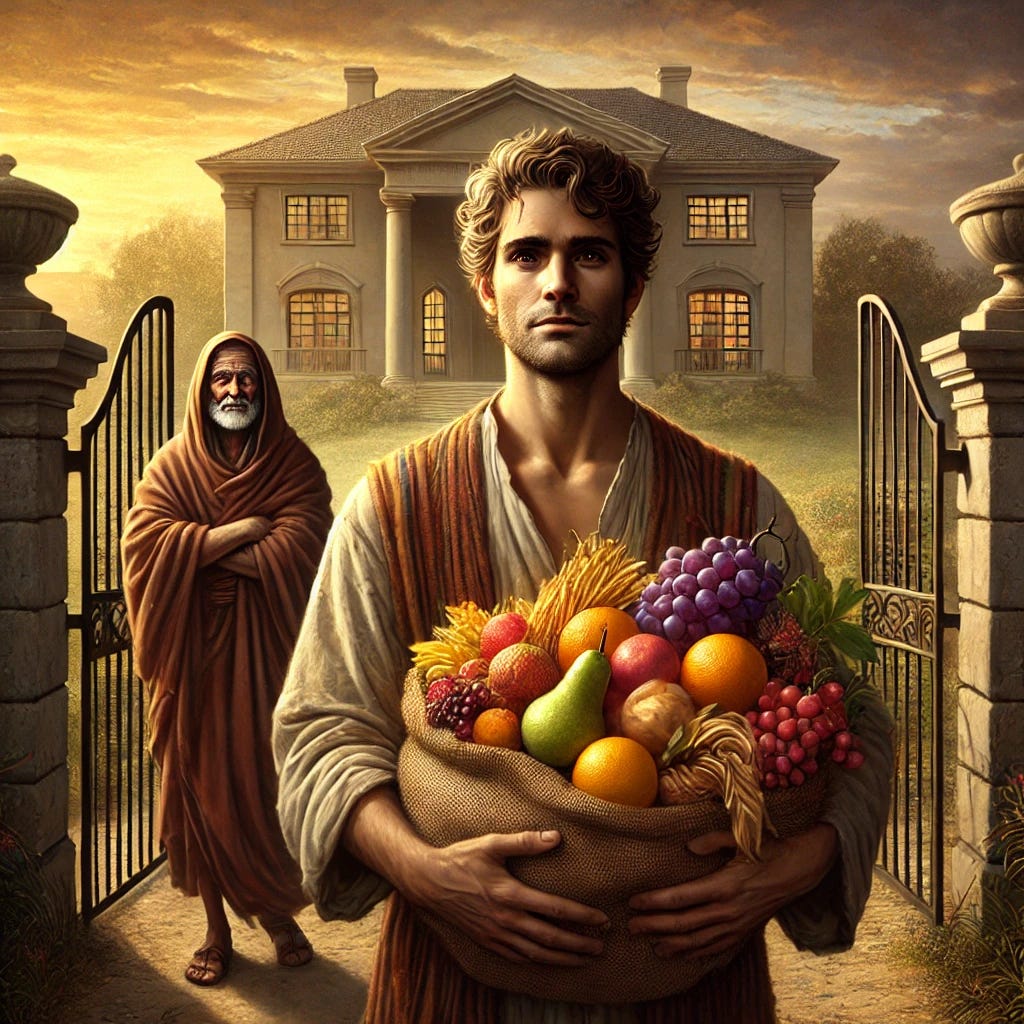
The Parable of the Prodigal Son is one of the most moving stories that Jesus told during his ministry. In this story, a young son demands his inheritance early from his father and journeys to a distant land where he squanders everything on wild and hedonistic living. After a severe famine leaves him destitute and feeding pigs for a living he "comes to himself" and decides to return home, hoping to be hired merely as a servant. But while he is still far off, his father spots him, runs to embrace him, and restores his status as a son by giving him a robe, ring, and celebratory feast in his honor. Its central message is that no one is ever too far gone to return home and fully share in the Father's bountiful inheritance.
While I can see how moving a story this is and how cathartic it must have been for both the father and his prodigal son, I could never truly identify with it in my own journey within and away from the restored Gospel of Jesus Christ. After thinking it through, I’ve come to realize that I can’t identify with it because my intent in leaving home to explore abroad was not to squander my inheritance hedonistically but to find the exotic fruits, spices, and treasure that can further enrich the Father’s inheritance, not squander it.
While the phases in this approach look similar from the outside, and often get confused with each other, they differ significantly in their ability to provide meaning, fulfillment, and ultimately, transcendence of the Gospel we have today. Historians and theologians have written plenty has about the prodigal son, so not much more needs to be said. However, I would instead like to add the Parable of The Parsimonious Son and his return to his father’s house to the apocryphal canon.
What’s the Difference Between the Prodigal and Parsimonious Son?
In the biblical context, "prodigal" refers to someone who spends resources wastefully and extravagantly. The term comes directly from the Latin "prodigus," meaning lavish or wasteful. In Jesus's parable, the younger son exemplifies this by quickly depleting his inheritance through "riotous living," suggesting indulgence in pleasures without restraint or consideration for the future. I believe Jesus portrays this behaviour negatively not merely because it leads to material poverty but because it represents spiritual poverty by choosing temporary gratification over a lasting relationship with the father.
However, parsimony in belief is about intellectual honesty and careful discernment. The parsimonious son examines his father's estate with a critical eye – not out of disrespect, but out of reverence for truth itself. He recognizes that some inherited beliefs are superfluous or cannot withstand scrutiny, while other valuable truths may be missing entirely. His journey from home becomes a deliberate process of stripping away unsupported assumptions while gathering robust insights that stand up to careful examination. Unlike the prodigal's wasteful abandonment, the parsimonious approach is selective retention and thoughtful acquisition.
This distinction fundamentally changes how we understand exploration beyond the confines of established doctrine. The prodigal son's departure represents hedonistic escapism, fleeing responsibility for pleasure's sake. By contrast, the parsimonious son's journey embodies rigorous truth-seeking through a sincere effort to distill essential wisdom from both within and outside traditional boundaries. Both may appear to leave the father's house but each have profoundly different intentions and outcomes. One returns humbled by failure, while the other returns bearing refined understanding – truths that withstood testing and new insights that complement the father's wisdom. This parsimonious approach doesn't seek to diminish the inheritance but purify and add to it.
Trying on the Armor of God
I was raised with a straightforward faith, handed down and received without question from goodly parents, and nourished incessantly within carefully drawn lines. The gospel I knew was a sapling tree within a pot in the garden. This garden had clear black-and-white boundaries to delineate between what was vibrant and beautiful. Still, with invisible fences, I was subtly trained never to challenge or cross behind which plants of unknown quality grew. I was taught as a young man that is putting on the armor of god, made entirely from the fruits wwithinthe garden, would always be sufficient for my spiritual needs.
I embraced the metaphor with exuberant naivety, convinced I was assembling an impenetrable spiritual defense. How prepared I thought I was! With my loins girt with truth (though it was merely familiar doctrine), the breastplate of righteousness firmly tightened (though it was simply outward compliance), my feet shod with the gospel of peace (though I'd never truly tested its resilience). I positioned the cardboard helmet of salvation on my head with ceremonial confidence, raised my paper-plate shield of faith, clutched what I imagined was the mighty sword of the spirit and thought myself ready to take on the powers and principalities of the rulers of darkness. I don’t feel too bad about this naivete since, as Paul mentions, when one is a child, one can’t help but think as one as well.
However, once I became a man, I maintained the belief that believing this spiritual disguise would suffice against any doubts or challenges that might come. It served it’s purpose well in in environments where I was insulated from the world, like at Brigham Young Univiersity and on a mission my belief thrived, but both my mission leadership and the people I taight could tell that there was a fire under the surface that just couldn’t find its way to the surface. Finding this spiritual fire I could only describe as the real, “terrible swift sword” of the spirit became a core desire of mine in my spiritual sword, but the more I paid attention to obeying the rules and the orthodox interpretation of doctrine the further that sword felt.
Little did I understand then that Alma's metaphor of planting and nourishing a seed of faith wasn't meant for cultivation in a decorative pot, kept safely indoors away from the elements, but rather for planting in wild, but fertile soil that was in, but not of the world. I realized my tree of faith grew in artificially controlled conditions, thriving only when fed with carefully measured nutrients, sheltered from intellectual storms, and trimmed whenever a branch grew in an unauthorized direction. I had mistaken memorization for understanding, cultural conformity for spiritual depth, and obedience for genuine conviction. The armor I'd so proudly assembled was more ceremonial than battle-tested, adequate for the spiritual parades of my youth but woefully insufficient for the genuine warfare of an examining mind.
Leaving Home to Find Truth through Parsimony
In the months after my mission, cracks appeared gradually in the carefully tended pot of my faith. They weren’t dramatic fissures, but rather hairline fractures where rigid doctrine met contrary lived experience and didn’t resolve. The superficial answers that had once satisfied me began to feel rehearsed, circular, and insufficient for the complexity of the real questions. I noticed how church lessons recycled the same stories with the same interpretations, year after year, without ever diving deeper into their thornier implications. This intellectual monotony created small but growing spaces where doubt could take root.
Leaving space for good faith doubt and criticism was gradual at first. Doubting that spiritual promptings that ended up being wrong could have come from God, noticing the good the church does for some and not others, and seeing excommunications for people that, as far as I could tell were trying to make the Church better opened the door to alternative voices. Then, a simple philosophy podcast challenging listeners to subject their beliefs to reasonable, good-faith criticism resonated with me more than any General Conference talk I’d ever heard had.
The call to criticize beliefs not with the intent to destroy them but to test if they would grow stronger or reveal themselves as incomplete was powerful for me. This seemingly small idea expanded Alma's seed experiment beyond Church truth to truth in general. After all, if truth is truth, shouldn't it flourish under scrutiny rather than wither? The seed metaphor Alma used to grow belief invited a broader application to testing its opposite. If a the seed of faith when planted grows into a tree of fruth, could planting the seed of doubt through reasonable criticism prune the tree of truth of unnecessary branches? Or even build a tree of truth rooted in doubt, not faith? And most importantly, why confine my experiment to the carefully controlled garden of institutional religion?
And so I set out, my spiritual inheritance in hand, not to waste it in "riotous living" like the prodigal son of old, but to invest it in a search for deeper understanding. The same principled experiment that had strengthened my faith within the Church now led me to test it against what I could find outside. I became not the prodigal but the parsimonious son, carefully examining each belief, retaining what proved valuable, and discarding what could not withstand honest scrutiny. This process wasn't about rebellion against truth but reverence for the truth in all its forms that could stand up to scrutiny. Thinking and speaking as a man now, I made a sincere commitment to seek the truth wherever I could find it. I wouldn't settle for comfortable half-answers or convenient simplifications anymore, so I ventured beyond my father's estate not to escape his wisdom but to discover which parts of it could withstand the winds outside the greenhouse and what other wisdom might be waiting to be gathered and brought home.
Finding Myself in Foreign Fields
The journey beyond my inherited faith didn't follow a single path but unfolded through distinct phases of discovery. I ventured first into epistemology and philosophy of religion to question not just what I knew, but also how I could know what was true at all. The shield of faith I'd once carried transformed into the lens of reason, something to see through rather than hide behind. Critical thinking became my companion, teaching me that the strength of a belief isn't measured by its comfort but by its resilience to scrutiny.
This search led naturally into empirical realms, physics, history, and psychology where I found truth that was testable, verifiable, and often more consistent in its application than what I'd inherited through religious sources. I discovered that religious experiences are psychologically universal rather than exclusive to tradition. The cosmos revealed its elegance through grand cosmology and minute quantum mechanics that made ‘small p’ prophecies by making predictions accurate enough to create technology that heals the sick, blind, and deaf. These insights didn't merely replace my faith; they transformed how I understood truth. Where I once sought certainty, I found beauty in patterns, complexity, and emergent order.
The problem, of course, was isolation. Truth-seeking was intellectually productive but spiritually lonely. Systems thinking and comparative mythology helped me recognize that the Church's narratives weren't necessarily factual but were encoding deeper truths—much like how other wisdom traditions clothe universal principles in culturally specific garments. I discovered what monastics have known for centuries: faith is not just individual revelation but also shared mythos and ritual—the power of community, structure, and purpose that gives meaning to insight.
The parsimony I sought wasn't about reducing everything to its simplest explanation but about finding the essential truths that transcend any single religious or secular framework. These truths didn't contradict my spiritual heritage but illuminated it from angles I'd never considered. The seed of secular exploration I planted when I left the church to seek on my own had blossomed into a fruit-bearing tree, but there was still something missing deep within me that my secular frameworks couldn’t fill.
Kicking Against the Spiritual Pricks
Like Saul, before his experience on the road to Damascus, I had made a name for myself, kicking against the spiritual pricks when interpreting and interacting with society. Yet I wasn't entirely set against spiritual truths either. Unlike Korihor, who likely sparked Alma's sermon on faith a few chapters later, I could embrace the "foolish traditions of my fathers" and accept revelation as the "effect of a frenzied mind" for what I thought they were—manifestations of shared mythology and spiritual experience among humans. I added their branches to my secular fruit tree and tasted them from time to time while remaining on high alert for anything genuinely supernatural.
I was wise to the tactic of "Jesus smuggling," where secular arguments have spiritual implications that make accepting Jesus a logical necessity. I resisted falling into what I saw as a spiritual trap. I observed many fellow wanderers in pursuit of truth find what I thought was a "hole-shaped God"—a version of spirituality tailored to fit within a broader secular paradigm. This approach felt dishonest to me, like paring back the fruit-bearing branches of a tree for the sake of having a parsimonious trunk.
I didn't anticipate how my professional work would create a church-shaped hole in my thinking. As I worked on complex systems and policy questions, I kept encountering situations where the ideal organizational structure mirrored the church: a central coordinating unit with grassroots organization locally, qualitative and quantitative research nestled within personal wise judgment, and networks of people united by a shared vision who contribute beyond expectations. I saw how perfectly positioned the church was to function as an aid and development organization while maintaining its spiritual focus.
Deciding to Stop Kicking
Somewhat related to the most significant and broadest professional thinking I was doing at the time, I experienced three manic episodes of varying intensity that are the closest I’ve been able to come to genuine spiritual experience. I’d hesitate to call them Pauline, but they were highly influential in opening my mind and softening my heart to return to a religious way of life.
Through these manias, I experienced different dimensions of spiritual understanding. First came a wild episode where I felt compelled to save the world from literal destruction, taking on the eschatological role of the savior with neither the patience nor power to fulfill the task. The second one placed me in a passive teaching role, developing my new rituals and speaking cryptically as ifreceiving revelation. However, there was no signal in the noise I spoke in my short time as a rabbi. The third, less delusional than the others but equally invigorating, centered not just on doing what Jesus said throughout his earthly ministry but on being even as he was,or embodying His approach to understanding the will of God, orienting Himself toward it, acting in such a way that His will is manifest, whether that’s the will of a divine being or the top of value hierarchy of secular meaning.
My "aha moment" came while contemplating this perspective of being like Jesus and what it meant to build Zion both secularly and spiritually. I was struck by how I might contribute to spreading the good news and doing the good work even without a traditional belief structure. The overlap between secular and religious approaches to creating a virtuous society became undeniable. I began focusing on what I could do rather than what I couldn't. I went from worrying about whether it was true. Maybe it's not true, to think that it only matters if it's true to me. The longer I’ve thought about it, the more I’m beginning to feel that, at the end of the day, it might not matter very muc,h which it is.
In the end, no one smuggled Jesus to me through clever argumentation or personal exhortation. Still, I realized He had been smuggling me back to his fold the whole time through my continual experiment of planting seeds of faith, cultivating them into trees of truth, and taking stock of the fruit they provide and how it might in some way contribute to building the kingdom of God on Earth. As I begin my return to my Father’s estate and the trees of truth that thrive in his garden, I hope to bring not only a renewed appreciation for the trees that gave me shade as I grew up but also anticipation of the opportunity to plant the new seeds of truth I found on my journey alongside them.

Contributing to the Welcome Feast
Unlike the prodigal who returns empty-handed and humbled by failure, ready to work the lowliest of jobs to repay his debt. The parsimonious son brings carefully curated treasures that complement rather than contradict his heritage and is willing to serve at the pleasure of his Father. As I arrive at my Father's estate, I come both bearing gifts and being willing to serve. It is my hope that the fruits gathered from distant lands might enrich our shared table and that my service planting and pruning in the garden might make thethe fruit, both new and old, born by the trees more delicious and desirable.
When I first read Alma 32, I understood it as instruction for growing faith in church doctrine. Now, I recognize it as a universal method for discerning truth in all its forms. Just as Alma borrowed from agriculture to create a religious metaphor, and now I'm borrowing from science and philosophy to enhance my spiritual understanding. The seed of faith experiment extends beyond church walls to all domains of knowledge such that a good seed produces good fruit if it’s tended and cultivated correctly regardless of where someone plants it.
Understanding the reality of who Jesus was and where His power lay transformed the paper armor of my youth and replaced it with a battle-tested set. The "terrible swift sword" from the Battle Hymn now represents not just some final judgment we’ll face eventually, but the ability to discern truth from error regardless of its source. The power to embody Christ's powerful approach and of understanding truth so intensely and expressing it so simply is in me now more than ever. And I hope to build on it by asking questions that expand limited perspectives, and speaking in ways that convey layers of meaning to different audiences as I continue to interact with people both within and outside the Church.
Standing at the threshold between rigid orthodoxy and heretical exploration, I see my role not as a gatekeeper but as a bridge-builder. This position isn't about compromising one set of values for another, but integrating them into a more complete whole. When I examine complex systems and long-horizon problems professionally, I see patterns that increasingly resemble what the church aspires to be: a community united by a shared vision, contributing toward building something greater than themselves. When I see the body of christ unite toward building something greater themselves, I see the tools of my secular profession ready and able to be used to build up Zion together, not matter whether the truth we hold to is literal or metaphorical.
I’m not expecting the Father to run toward me "while he was yet a great way off," but I am hoping to be met halfway by Him. In return, I’ll commit to meeting anyone halfway that’s making their own trip home. If there is a feast to celebrate my return I hope it will mark the beginning of a new journey to venture out and find my fellow wanderers and offer them a guide back home where their own feast is waiting that’s only missing their own secret ingredients they’ve found a long the way.