
The Knights of the Squared Circle
Distilling Absurdity and Practicality into Faithful Action by Applying Kierkegaard’s Double Movement to Institutional Dysfunction
Loyal Dissident and Devout Heretic of Institutions in Distress
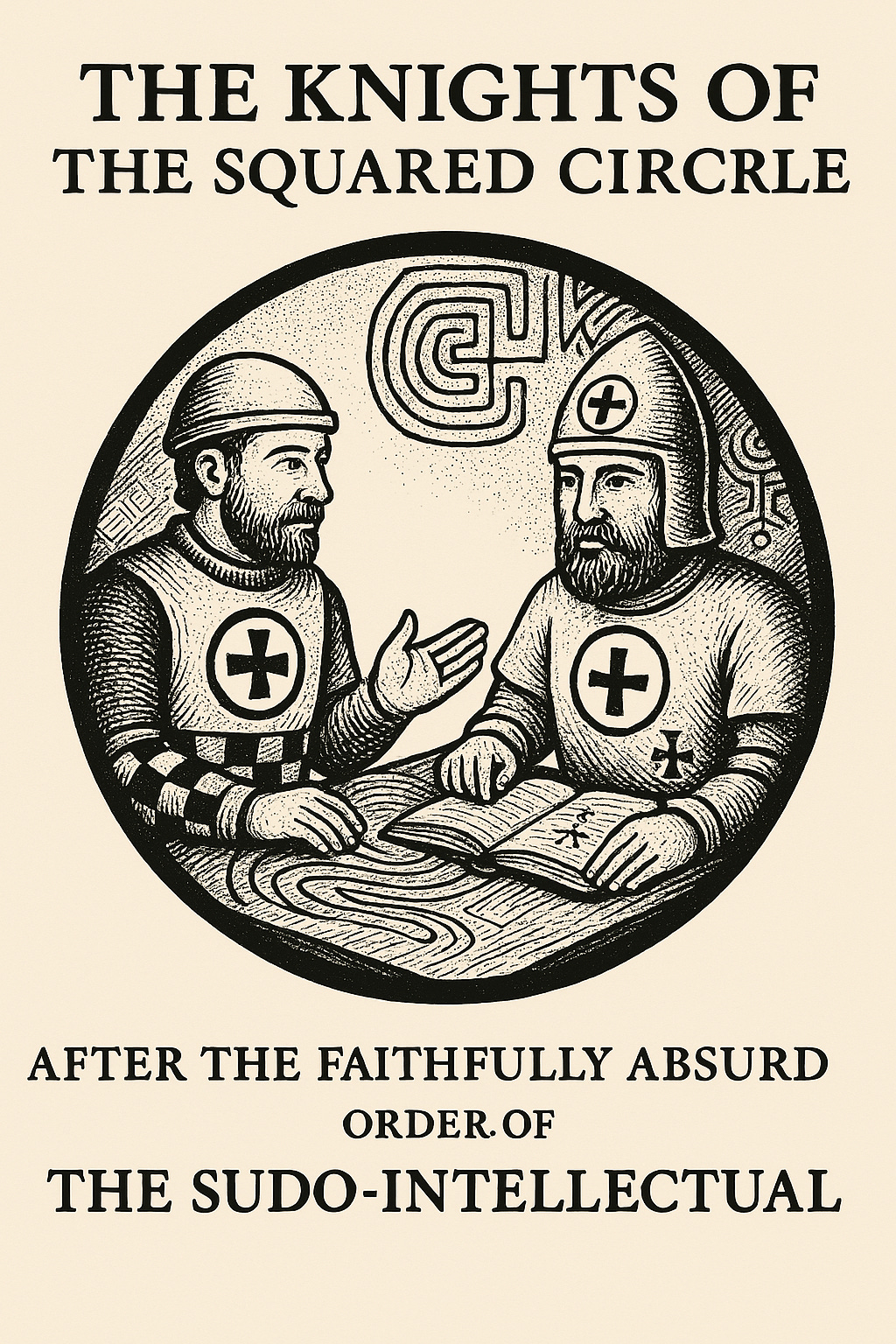
In medieval times, mathematicians struggled with the holy grail of a problem to "square the circle" which means constructing a square with the same area as a given circle using only a compass and straightedge. For centuries, this challenge represented the seemingly impossible in a similar fashion that finding the holy grail was elusive, until mathematicians finally proved it could not be done with those limited tools. Yet paradoxically, by expanding their toolset and reimagining the problem, later thinkers found ways to create approximations that are minimally different from the impossible ideal solution.
Today we face our own version of this ancient puzzle. Our institutions have become square frames as rigid, structured systems designed for efficiency and scale. Meanwhile, our deeper purposes remain circular as flowing, continuous, and connected to transcendent meanings. The disconnect between these shapes manifests as institutional dysfunction, where our organizations may efficiently perform tasks yet lose sight of their founding purpose.
This essay argues that the Knights of the Squared Circle, through the Code of Absurdity presented herein, provide not only an individual path toward meaning in improving institutional functioning but also a transformative methodology that produces both the people capable of institutional reform and the institutional environments receptive to renewal. By embodying and moving through the different knightly archetypes and acting with the sudo-intellectual methodology, individuals develop the capacity to reconnect members of dysfunctional systems with their founding values while simultaneously creating conditions where institutions can sustainably and effectively act in more and more accordance with those values.
A Check-up with Dr. Kierkegaard
In the midst of 19th-century Denmark's comfortable prosperity, Søren Kierkegaard emerged as a penetrating diagnostician of society's hidden spiritual ailments. While his contemporaries celebrated progress, reason, and social advancement, Kierkegaard detected a profound malaise beneath the surface—a crisis of meaning that technical achievements and material comforts could not address. Like a physician who discerns a life-threatening condition in a seemingly healthy patient, he identified symptoms of cultural decay that others dismissed or failed to recognize. His philosophical works, often written under pseudonyms and employing indirect communication, served as both diagnostic tools and potential remedies for what he saw as the spiritual sickness of his age.
Kierkegaard wrote against the backdrop of Danish society's nominal Christianity—a cultural Christianity that demanded little and offered even less in terms of authentic spiritual engagement. This context allowed him to develop a critical perspective that extends far beyond religious institutions to all human organizations that lose sight of their founding purposes. His insights into how individuals relate to collectives, how reflection can displace action, and how qualitative distinctions become flattened by quantitative measures offer us a framework for understanding our own institutional dysfunctions. By examining Kierkegaard's diagnosis in detail, we can better understand not just the symptoms but the underlying conditions of our modern institutional maladies.
Kierkegaard's Prophetic Diagnosis
Kierkegaard identified three interconnected dysfunctions that plague modern, both his and ours, institutional life, with each revealing a different dimension of how our organizations lose their connection to meaning and purpose.
First, "the sickness unto death" describes a form of existential despair that emerges when individuals surrender their personal responsibility and authentic selfhood to abstract systems and collective identities. Within institutions, this manifests as a pervasive alienation where participants follow procedures and protocols without understanding their deeper purpose. Workers become functionaries rather than agents, going through motions established by distant authorities rather than engaging meaningfully with the work itself. This creates organizations full of people who are present physically but absent spiritually.
Second, "the present age" refers to a cultural condition characterized by endless reflection without decisive action, where everything becomes flattened into spectacle or entertainment. In institutional settings, this appears as an obsession with analysis, reporting, and deliberation that never culminates in meaningful change. Organizations become trapped in cycles of meetings about meetings, studies about studies, and reforms about reforms—consuming enormous resources while postponing indefinitely the substantive work they were created to perform. The institutional capacity for decisive commitment atrophies while the capacity for documentation expands.
Third, "the leveling process" describes how bureaucratic systems reduce qualitative human experiences to quantitative measurements, eliminating the distinctions that give life meaning. Institutionally, this manifests as the tyranny of metrics, where only what can be measured is valued, and only what is valued gets measured. The richness of human experience and the complexity of real-world problems become flattened into dashboards, scorecards, and performance indicators that capture the countable while missing what counts. Quality becomes subordinated to quantity, wisdom to information, and purpose to process.
Our Bleak Prognosis
The prognosis for institutions afflicted by these conditions, without intervention, is grim: increasing disconnect between daily activities and founding missions, spiritual emptiness despite material and technological abundance, and the triumph of what Kierkegaard called "the numerical" where worth is determined by abstractions rather than authentic engagement. These dysfunctions operate cyclically and reinforce each other: despair leads to passivity, passivity enables leveling, and leveling deepens despair.
At their core, these dysfunctions represent a fundamental misalignment between institutional structures (rigid, bounded systems designed for efficiency and scale) and their animating purposes (flowing, continuous connections to deeper meaning and values). Modern institutions have become highly effective at self-perpetuation while forgetting why they exist in the first place.
This creates a paradoxical situation where organizations simultaneously function efficiently and fail completely, not unlike a train that runs perfectly on time while traveling in the wrong direction. This disconnect between means and ends represents a contemporary version of the ancient mathematical puzzle of "squaring the circle"—attempting to unite fundamentally different geometric realities within a single coherent framework.
The Course of Treatment
Kierkegaard's Circle
Kierkegaard's solution centers on personal transformation through his concept of the "knights of faith." These knights make a double movement: first resigning all hope in finite solutions, then paradoxically reclaiming the finite world through an "absurd" faith that acts despite impossibility. This circular journey begins with the Knight Who Says Ni, who recognizes absurdity and rebels against it; progresses to the Knight of Infinite Resignation, who withdraws from immediate action to develop deeper understanding; and culminates in the Knight of Faith, who returns to the world with transformed purpose.
These knightly archetypes represent a spiritual path that allows individuals to maintain meaning and purpose even within dysfunctional systems. They develop the courage to question established frameworks, the resilience to persist through apparent failure, and the wisdom to reconnect action with deeper purpose. Like a circle, this journey has no end point—it continues through cycles of recognition, resignation, and faithful return, each time deepening one's capacity to live authentically amidst absurdity.
Sudo-Intellectual's Square
The Sudo-Intellectual Framework offers a complementary square—a structured methodology for systemic change with clear boundaries and defined processes. This framework moves through three phases: creative disruption (Pseudo), where divergent thinking breaks open closed systems of thought; strategic planning (Meta), where critique evolves into comprehensive design; and faithful implementation (Sudo), where vision becomes concrete reality through disciplined action.
Unlike Kierkegaard's primarily personal and spiritual approach, the Sudo-Intellectual Framework directly addresses institutional structures and processes. It provides practical tools for imagining alternative futures, developing systematic understanding of how systems function and fail, and implementing transformative initiatives with continuous evaluation. This square framework creates boundaries that enable focused action while ensuring that personal transformation translates into tangible institutional impact.
Squaring the Circle of Institutional Dysfunction
When Kierkegaard's circular personal journey integrates with the Sudo-Intellectual's square framework, we discover a profound complementarity that addresses both personal and institutional dimensions of our crisis. The Knight Who Says Ni aligns with the Pseudo phase of creative disruption; the Knight of Infinite Resignation corresponds to the Meta phase of strategic planning; and the Knight of Faith parallels the Sudo phase of purposeful implementation.
This integration creates regenerative cycles—"holy loops"—where personal transformation fuels institutional renewal, which in turn creates environments more conducive to authentic existence. Each iteration doesn't just solve problems but builds capacity for addressing future challenges while strengthening connections to founding purposes. Like the ancient mathematical problem of squaring the circle, this synthesis approximates what is impossible in theory: uniting the flowing, continuous nature of personal meaning with the structured, bounded nature of institutional systems.
The Kierkegaardian-Sudo synthesis offers neither revolutionary destruction nor reactionary retrenchment, but rather a path of radical incremental transformation that honors both the depths of personal faith and the breadths of systemic complexity. It suggests that by embodying the movements between these knightly archetypes, individuals can develop precisely the qualities needed for meaningful reform while simultaneously creating institutional environments receptive to renewal.
The Code of Absurdity for Modern Knighthood
Our modern condition requires a new code - a Code of Absurdity for the Knights of this Squared Circle who engage in the quixotic quest of uniting the secular square and spiritual circle. These knights understand that in a world where institutional purpose has been forgotten, only seemingly absurd actions can break the frame enough to reconnect systems to their founding values. Like Don Quixote charging at windmills, they may appear ridiculous to conventional observers. Yet their apparent madness contains a method that conventional approaches lack - the ability to see beyond established frameworks.
The Knights of the Squared Circle take their name from this paradoxical mission. They seek to unite what appears impossible to unite: the square frame of systematic methodology with the circular lens of existential meaning. They recognize that personal transformation without institutional impact remains incomplete, while institutional reform without spiritual depth becomes another soulless process.
These knights wield both compass and straightedge - both the tools of spiritual orientation and systematic construction. They understand that addressing institutional challenges requires both the absurd courage to see deeper purposes where others see only bureaucratic procedures and the disciplined planning to engage them effectively.
In the sections that follow, we will explore the three archetypes that comprise the Knights of the Squared Circle and discover how their progression offers not just a path for individual meaning-making but a methodology for institutional renewal.
The Personal Movements of a Knight of the Squared Circle
The Knight Who Says Ni: Beginning in the Pseudo Mode
"NI! NI! NI! Bring us... a shrubbery!"
Remember the Knights Who Say Ni from Monty Python? They demanded nonsensical things from travelers passing through their forest. This absurd humor captures the first stance toward broken systems: creative resistance through absurdity.
The Knight Who Says Ni understands that when a system has become so serious that it can no longer solve the problems it was designed to address, only humor can break its spell. This knight operates in "Pseudo Mode"—performing knowledge they don't necessarily possess and authority they don't necessarily claim, making strange demands that expose the arbitrariness of all demands.
Consider James, a public servant in a government agency tasked with innovating service delivery. When he proposes ideas that could genuinely help citizens, he faces endless bureaucratic roadblocks: "That's not how we do things," or "We need seven more committees to approve this."
Rather than rage against the machine or surrender to it, James becomes a Knight Who Says Ni. He begins employing creative absurdity, He creates elaborate, nonsensical acronyms for his proposals that mirror the agency's love of meaningless abbreviations. He organizes meetings about meetings about meetings, highlighting the recursive bureaucracy. He performs governance theater with exaggerated seriousness, making visible the absurdity of empty rituals
James isn't being childish or unprofessional. He's using absurdity strategically—exposing the system's contradictions by taking its logic to extremes. His colleagues might laugh, roll their eyes, or even get annoyed, but some begin to see their work differently. The absurdity creates tiny cracks in the façade of normalcy.
The Knight Who Says Ni doesn't believe in the system but remains somewhat provocatively loud within it. This stage is characterized by the malicious compliance of going through the motions of the work to observe and exemplify the absurdity of its rituals, engaging in meme warfare that communicates deep truths through seemingly shallow jokes, and speaking in tongues by using language, behavior, or jargon that is correct but can’t possibly be understood.
The First Movement: From Ni to Resignation
Eventually, the Knight Who Says Ni realizes that pointing out absurdity isn't enough. The system's dysfunction runs too deep for mere exposure to fix it. This realization leads to the first movement in Kierkegaard's dialectic: the movement of infinite resignation.
For James, this happens when his creative resistance reaches its limits. His absurdist tactics have helped colleagues see problems and think of absurd solutions, but like the bureaucracy in Catch-22, the system remains unchanged. After a particularly frustrating project cancellation, James makes a profound decision: he surrenders his identity as a reformer from within.
This isn't giving up, but rather a strategic withdrawal. James applies to graduate school in public policy, stepping back from daily battles to gain perspective and develop deeper understanding. He resigns himself to the impossibility of changing the system as it currently exists, which paradoxically frees him to understand it more completely in imagine what it could be.
The Knight of Infinite Resignation: The Meta Mode
"I give up," says the Knight of Infinite Resignation. "But I'll keep notes on what could have been."
The Knight of Infinite Resignation withdraws to the mountain—literal or metaphorical—to plan impossible realities. Having given up on immediate transformation, this knight gains the freedom to design better systems without the constraints of "practicality" or "political feasibility." This is the "Meta Mode"—reflection, planning, and design from a position of deliberate exile.
James becomes this knight in graduate school. While his classmates debate minor policy adjustments, he drafts radical reimaginings of the governance from which he came and proposals for where he’d like to be. He studies complex systems theory, organizational psychology, and historical precedents for institutional transformation. He writes papers that his professors find "interesting but impractical" about governance models that don't yet exist snd include concepts from foreign fields.
To outside observers, the Knight of Infinite Resignation appears to have given up and walked away from his sacred mission in favory of fantasy. James works diligently on theoretical frameworks that seem disconnected from real-world application. He attends required networking events but speaks less about immediate policy fixes and more about fundamental system redesign. Some classmates find him overly pessimistic, others naively idealistic.
But internally, this knight is mapping unexplored territories of thought. He engages in prayerful planning, treating theory as theology to develop developing secularly sacred blueprints for a better world. He falls in love with the silence of the mountain, stepping back from daily noise to hear the deeper patterns. He writes constitutions for nations that don't exist and designs systems from first principles, unconstrained by the course of history and current reality.
The Knight of Infinite Resignation accepts the world as it is while refusing to accept that it must remain so. This tension between resignation to current reality and hope for transformation creates a dynamic tension between pseudo-reality, or an idealistic world that could in theory exist, and sudo-reallity, the similarly idealistic world that can be implemented in practice. This tension creates a productive space for imagination and design that enables the innovation and creativity that was stifled as a knight who says ni.
The Second Movement: From Resignation to Faith
While resignation is necessary, it isn't sufficient. After developing a vision for what could be, the knight must make a second movement: the return to the world with a transformed perspective. This is what Kierkegaard calls the "leap of faith"—not a blind jump into irrationality, but a commitment to act in the present world oriented toward a different future.
For James, this happens when he completes his studies and must decide his next step. He could pursue prestigious policy positions or academic roles that would keep him in the realm of theory. Instead, he makes a surprising choice: he returns to public service, but at the local level, in a small community office where he can directly engage with citizens and has more autonomy over what projects and programs do or not reach implementation.
This isn't a regression, a compromise, or a ‘settling’ it's the second movement of faith. James returns to the world he had resigned, but now he carries within him both the creative resistance of the Knight Who Says Ni and the visionary planning of the Knight of Infinite Resignation. Together, they make the leap into faith that by their integration pseudo-utopia and sudo-reality, or in Kierkegaard’s terms the infinite and the finite, might meet within the knight of faith.
The Knight of Faith: The Sudo Mode
"sudo apt-get install utopia"
The Knight of Faith walks back into the world they had abandoned, but with a crucial difference—they have prepared themselves to be worthy of what Kierkegaard calls the "teleological suspension of the ethical." This is the capacity to act beyond conventional morality in service of a higher purpose, just as Abraham was willing to sacrifice Isaac in obedience to God while paradoxically trusting God would fulfill his future promise of abundant progeny through Isaac.
In computing terms, the knight of faith is prepared to operate with "sudo" privileges, which is a command that executes actions with higher authority than normally available. The knight of faith’s transformation is so complete, however, that they rarely, if ever, need to invoke these privileges explicitly. Like Abraham who raised the knife but never had to use it, they work within existing systems with such authenticity and purpose that the systems begin to reform around them. James prepares for radical interventions he may never need to execute because his daily actions which are now infused with transcendent meaning gradually transform the system from within.
In his new role, James becomes this knight. He processes permit applications, organizes community meetings, and manages local services—mundane tasks similar to his previous work. But he approaches them with a transformed consciousness that comes from having completed both movements. He treats each citizen interaction as if it were already happening within the governance model he designed in theory, seeing the seed of his vision in every exchange. He stands ready to implement radical ideas, but discovers that small adjustments made with absolute conviction often accomplish more than dramatic overhauls. And he builds relationships not as strategic alliances for future change, but as expressions of the community and collaboration he knows is already possible.
To outside observers, James seems like a dedicated civil servant with unusual patience and purpose. He doesn't rant about systemic problems or grand theories. He simply serves his community with extraordinary attention and care. But those who work closely with him notice something different—a peculiar quality Kierkegaard called "inwardness," where outward conformity to social norms coexists with an inward commitment to something beyond those norms. They sense his preparedness to transcend conventional boundaries if necessary, while paradoxically observing his perfect comfort within them.
The Knight of Faith lives what Kierkegaard called the "double movement"—having given up all hope in finite solutions (first movement), and immersed themselves in infinite possibility, they paradoxically reclaim the finite world with new significance (second movement). This paradox manifests as "Sudo Mode"—a state of being where one prepares for exceptional action while finding that mere preparation often renders the action unnecessary:
These movements are not of the mass mobilization variety but are rather profound internal changes, or movements, in perspective, orientation, and loyalty. At Sudo-intellectual, we refer to the fruits of this second movement as:
Liturgy in motion, or treating mundane tasks as rituals by recognizing them as sacred in a way hidden to others
Absurd readiness, or maintaining the capacity for radical action while finding that the very preparation transforms ordinary actions into extraordinary ones
The paradox of non-action: Like Abraham who raised the knife but never had to bring it down, discovering that being prepared to transcend the system often allows one to fulfill its true purpose from within
The Unifying Journey From Pseudo-Absurdity to Sudo-Faith
When we integrate Kierkegaard's existential theology with the Sudo-Intellectual Framework, we discover more than a coincidental alignment—we uncover a profound complementarity between sacred personal development and institutional systems thinking. This section explores how these two approaches intertwine like a double helix, each strengthening the other to create a comprehensive approach to both individual and systemic transformation.
The Sacred-Secular Synthesis
Kierkegaard wrote in a 19th-century context of religious decline and institutional Christianity's failure to embody authentic faith. His emphasis on the individual's relationship with the Absolute (God) seems, at first glance, to have little connection to modern systems thinking or institutional reform. Yet his diagnosis of modernity's spiritual crisis parallels contemporary diagnoses of institutional dysfunction.
The Sudo-Intellectual Framework, with its structured approach to imagining, planning, and implementing systemic change, appears similarly distant from Kierkegaard's concerns with faith, absurdity, and transcendence. Yet both address the same fundamental human challenge: how to maintain meaning and purpose in the face of systems that have lost their connection to their founding values.
This synthesis isn't just academic—it addresses a crucial gap in both approaches. Kierkegaard's knights risk becoming isolated spiritual virtuosos without concrete impact on social systems, while system reformers risk becoming efficient technicians of meaningless processes without the spiritual depth to sustain their work. When combined, they create a model that is both deeply personal and broadly systemic, both spiritually grounded and practically effective.
The Cognitive-Spiritual Circuit: Mapping Internal States to External Systems
Kierkegaard's knights embody specific cognitive and spiritual states that align with phases in the Sudo-Intellectual Framework. This alignment creates a circuit where internal transformation drives external reform, which in turn deepens internal transformation.
1. The Absurd Imagination: Knight Who Says Ni <> Pseudo Mode
The Knight Who Says Ni operates primarily in what psychologists call System 1 cognition—intuitive, pattern-breaking, and emotionally charged. This knight's rebellion against absurdity is fueled by immediate recognition of disconnect between what is and what should be. In Kierkegaardian terms, this is the moment of realizing that conventional ethics and social norms have failed to connect humans to the Absolute.
This maps perfectly to the "Pseudo" phase of the Sudo-Intellectual Framework, where divergent thinking breaks open closed systems of thought. Here we find:
Utopia: Imagining alternative futures that conventional thinking dismisses as impossible
Advocacy: Articulating demands that establish new horizons of possibility
Conspirator: Identifying communities of creative dissent wherever they may be that challenge institutional inertia
Both the Knight Who Says Ni and the Pseudo phase serve the same function: they perform a necessary desecration of dysfunctional orthodoxies. Just as Kierkegaard challenged the complacent Christianity of his day, the Pseudo-Intellectual challenges the unquestioned assumptions underlying institutional failure.
This phase is spiritually analogous to the "via negativa" in mystical theology—the path of negation that begins by clearing away false images of God. Both the Knight Who Says Ni and the Pseudo-Intellectual clear away false images of what institutions are and could be.
2. The Sacred Withdrawal: Knight of Infinite Resignation <> Meta Mode
The Knight of Infinite Resignation transitions into a balanced integration of System 1 and System 2 cognition—combining intuitive understanding with analytical reflection. This balance enables the knight to plan comprehensively while maintaining spiritual depth. In Kierkegaard's framework, this represents the movement of resignation where one surrenders attachment to finite outcomes while preserving the infinite passion that drove those attachments.
This corresponds to the "Meta" or Planning phase in the Sudo-Intellectual Framework, where critique evolves into design:
Frameworks Development: Developing systematic understanding of how systems function and fail
Strategic Planning: Creating roadmaps for transformation based on comprehensive analysis
Project Management: Breaking down transcendent purposes into manageable actions
Both the Knight of Infinite Resignation and the Meta phase planners achieve a paradoxical freedom through constraint. The knight gains spiritual freedom by accepting limitation; the planner gains creative freedom by accepting structural requirements. Both withdraw from immediate action to establish the conditions for more meaningful action later.
This phase parallels what contemplative traditions call "recollection" or "gathering"—the practice of stepping back from the world to see it more clearly. The Meta planner, like the monastic scholar, works in temporary isolation to develop frameworks that will eventually reconnect with the world.
3. The Absurd Implementation: Knight of Faith <> Sudo Mode
The Knight of Faith primarily engages System 2 cognition—deliberate, practical, and operational—but with a crucial difference: this analytical thinking is animated by absurd faith that transcends analysis. The knight acts precisely and methodically in the world while maintaining an inner orientation toward the impossible. In Kierkegaard's terms, this is the second movement of faith, where one returns to the finite world after having resigned it, now seeing it transformed through relationship with the Absolute.
This aligns with the "Sudo" phase of implementation in the Framework:
Controlled Implementation: Testing and implementing transformative initiatives
Continous Evaluation and Imprvement: Fine-tuning interventions based on feedback
Participatory Engagement: Building structures that include input from all types and level of stakeholder
Both the Knight of Faith and the Sudo practitioner achieve impact not by revolutionary disruption but by faithful presence within existing systems. They operate from a position of paradoxical authority—commanding reality not through force but through authentic alignment with deeper purposes that the systems themselves have forgotten.
This phase resembles what mystical traditions call "incarnational spirituality"—the practice of manifesting transcendent reality through concrete, embodied action. The Sudo implementer, like the parish priest or the engaged contemplative, brings abstract ideals into practical reality through daily, disciplined service.
The Twin Movements: Leaps of Faith and System Iterations
Kierkegaard described faith as requiring two movements that appear contradictory: infinite resignation (giving up the world) and faith (reclaiming it). These movements find their systemic parallel in the Sudo-Intellectual Framework's iterative cycles:
The First Movement: Breaking and Rebuilding Mental Models
The movement from Ni to Infinite Resignation parallels the movement from Pseudo to Meta phases. Both involve, recognizing the limitations of current frameworks, withdrawing from immediate action to develop deeper understanding, building comprehensive alternatives to failed systems, and accepting the paradox of planning for what seems impossible.
This first iteration establishes what systems thinkers call a "mental model"—a comprehensive understanding of how components interact within a whole. For Kierkegaard, this mental model is profoundly personal and spiritual; for the Sudo-Intellectual, it may be organizational or institutional. But both recognize that transformation begins with reimagining relationships between parts and wholes.
The Second Movement: From Contemplation to Action
The movement from Infinite Resignation to Faith parallels the movement from Meta to Sudo phases. Both involve returning to the world with transformed purpose, translating comprehensive understanding into specific actions, maintaining paradoxical relationship to outcomes (working for results while detached from results), and creating islands of meaning within systems of meaninglessness.
This second iteration creates what systems thinkers call "feedback loops"—cycles of action and response that allow continuous learning and adaptation. For Kierkegaard, this feedback comes through the ongoing relationship with the Absolute; for the Sudo-Intellectual, it comes through measurement and calibration. But both recognize that transformation requires not just implementation but continuous responsiveness to reality.
Transcending the Theory-Practice Divide
Perhaps the most profound alignment between Kierkegaard and the Sudo-Intellectual Framework is their shared rejection of the false dichotomy between theory and practice, between contemplation and action. Both integrate these supposedly opposed elements into a unified approach:
Practical Theory: Both Kierkegaard and the Framework insist that theory must be lived to be meaningful. Kierkegaard dismissed abstract philosophical systems that didn't transform the philosopher's life; the Framework rejects planning that doesn't lead to concrete deployment.
Theoretical Practice: Both also maintain that practice must be theoretically informed to be transformative. Kierkegaard criticized mindless religious observance; the Framework criticizes reactive interventions without strategic depth.
Ongoing Dialectic: Most importantly, both see the relationship between theory and practice as dialectical rather than linear. The Knight of Faith doesn't move beyond theory into practice; they live the unity of both. Similarly, the Sudo-Intellectual doesn't complete planning and then implement; they maintain a continuous cycle where implementation generates new insights that inform ongoing planning.
Institutional Embodiment: From Individual Knights to Organizational Culture
While Kierkegaard focused primarily on individual transformation, his knights offer models for institutional culture as well. When an organization embodies these knightly qualities across its structure, it creates what organizational theorists call a "learning organization"—one capable of continuous adaptation and renewal:
Pseudo / Ni Culture: Departments or teams dedicated to questioning assumptions, imagining alternatives, and pushing boundaries. These might be R&D units, skunkworks projects, or dedicated innovation teams.
Meta / Resignation Culture: Strategic planning functions that transform critique into comprehensive frameworks. These include not just formal planning departments but any processes that facilitate reflection on purpose and direction.
Sudo / Faith Culture: Operational teams that implement with both precision and purpose, maintaining connection to founding values while adapting to changing conditions. These are the frontline workers and managers who translate vision into reality.
The movement between these cultural modes creates what systems theorists call "adaptive capacity"—the ability to respond effectively to changing circumstances while maintaining core identity and purpose. This is the organizational equivalent of the Knight of Faith's capacity to remain true to the Absolute while fully engaged with the relative.
Regenerative Cycles: The Holy Loop
The integration of Kierkegaard's sacred philosophy with the secular Sudo-Intellectual methodology creates not a linear progression but a regenerative cycle—what we might call a "holy loop":
The Knight Who Says Ni breaks open dysfunctional patterns through absurd resistance, creating space for new possibilities (Pseudo phase).
This space enables the Knight of Infinite Resignation to develop comprehensive alternatives through strategic withdrawal, establishing blueprints for transformation (Meta phase).
These blueprints guide the Knight of Faith in implementing targeted interventions that maintain paradoxical relationship to both means and ends (Sudo phase).
As these interventions interact with existing systems, they generate new insights that fuel the next cycle of creative disruption, strategic planning, and faithful implementation.
This loop isn't just personally sustaining—it's institutionally regenerative. Each cycle doesn't just solve problems but builds capacity for solving future problems. Each intervention doesn't just fix dysfunction but strengthens the system's connection to its founding purpose.
The Kierkegaardian-Sudo synthesis offers a path that is neither revolutionary nor reactionary, neither purely individual nor blindly collective. It is instead a middle way—a path of radical incremental transformation that honors both the depths of personal faith and the breadths of systemic complexity.
In a world where institutions increasingly lose connection to their founding purposes—where healthcare systems forget healing, educational systems forget learning, governance systems forget justice—this synthesis offers a pathway to institutional renewal rooted in personal transformation. It suggests that the knight and the system, the soul and the structure, the sacred and the secular are not opposed but complementary elements in the ongoing work of aligning finite actions with infinite purposes.
The Quixotic Conclusions to the Quest of the Knights of the Squared Circle
Consider literature's most famous knight, Don Quixote, who saw giants where others saw windmills. Cervantes gave us not just a madman but a profound archetype of the Knight Who Says Ni—someone who refuses to accept the diminished reality others take for granted. His absurd quest creates moments of true nobility in a world that has forgotten what nobility means. He tilts at windmills, fighting myths, shaping meaning through apparent absurdity.
Consider too his faithful companion, Sancho Panza—the reluctant Knight of Infinite Resignation. He carries the bags, documents the delusions, plans for contingencies. He knows his master is mad and the quest impossible—but he resigns himself to it anyway, packing provisions, tending wounds, and keeping track of the story as it unfolds. He is the planner who accepts impossibility while still preparing for it.
Together, they embody not a completed transformation but a quest in progress—one that inspires those who witness it. The innkeepers, priests, barbers, and nobles who encounter Don Quixote and Sancho find themselves changed, often despite themselves. Some begin as mockers and end as believers—not in giants, perhaps, but in the possibility that the world might be more than it appears. These witnesses represent the potential Knights of Faith, those who integrate both the madness of Quixote and the pragmatism of Sancho into a new way of engaging reality.
The synthesis of Kierkegaard's Knights and the Sudo-Intellectual Framework offers a similar path for individuals seeking meaning and effectiveness in dysfunctional times to become Knights of the Squared Circle, wherever they are in their journey. It acknowledges both the absurdity of our current condition and the possibility of transformation through a disciplined progression: from the creative resistance of Quixote, through the strategic resignation of Sancho, to the faithful return of those they inspire.
This path doesn't promise quick fixes or revolutionary change. It offers something more subtle but perhaps more sustainable: a way to maintain human dignity and purpose within broken systems while patiently working toward their transformation. Like Quixote and Sancho, the Knights of the Squared Circle navigate the absurd with both a trembling heart and a steady hand, aligning themselves and their small corner of the world with something larger, one finite step at a time.
In a world where institutions increasingly fail their purposes, perhaps we need fewer revolutionaries promising total transformation and more Knights of Faith enacting partial transformation—creating spaces where broken systems begin to heal from the inside out. Like those who encountered Don Quixote, we might find ourselves wondering: what if those windmills were giants all along? What if our madmen and planners see more clearly than those who mock them?
The question isn't whether the windmills are actually giants—the question is whether treating them as giants, with loyal assistants by our side who see them for the windmills they are, might restore a form of enchantment that our disenchanted institutions desperately need. The Knights of the Squared Circle suggest that meaning emerges precisely where it should not be possible, and that the infinite purpose of human institutions becomes visible again through finite, faithful action—even if that action begins with a seemingly absurd charge at an ordinary windmill.
This leap into faith the Knights of the Squared Circle make is not just a jump into the void, but a leap to the place where the void touches the eternal and reflects it back into reality. It is there, perilously suspended between the finite and infinite, that we discover our capacity to transform both ourselves and the world around us. I am a Knight of Faith who believes in our potential to transform institutional dysfunction into vitality. Whichever stage of knighthood you’re at, I hope you’ll join me in the leap.