
Finding the Sweet Spot
Ensuring the Effectiveness and Implementability of Post-Growth Toolkits
Just as Kate Raworth's Doughnut Economics framework identifies a "safe and just space" between social foundations and ecological ceilings, policymakers face a similar challenge when implementing post-growth policies. They must navigate between what is ecologically necessary and what is politically feasible. Too radical, and policies risk rejection by existing institutions; too timid, and they fail to address our planetary crisis. The sweet spot lies in policies that both respect ecological boundaries and can gain traction in our current political landscape.
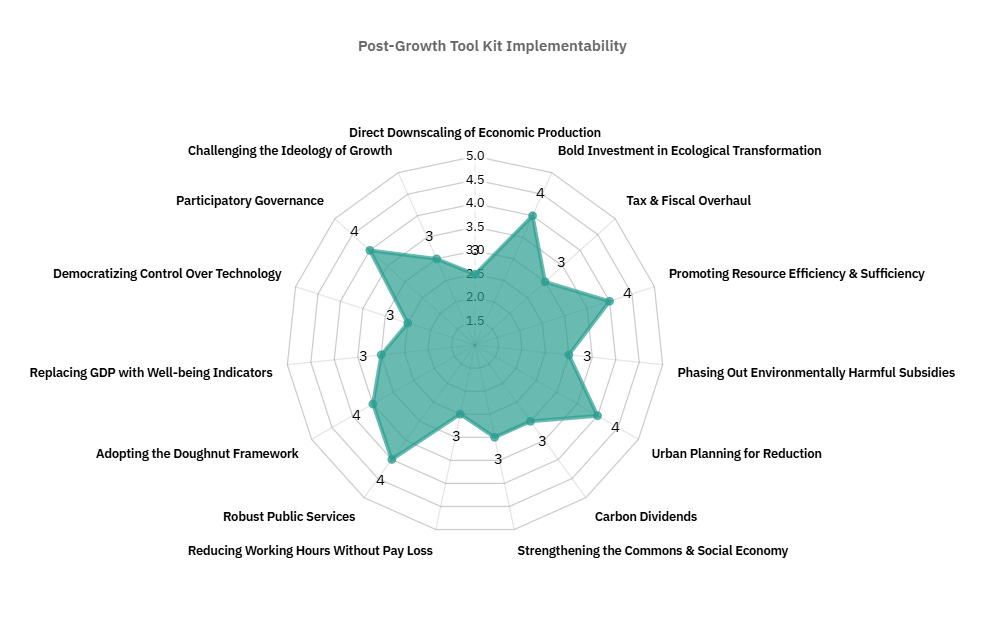
The radar chart presented here evaluates the post-growth policy toolkit through this lens of implementability. Each policy has been assessed on a scale from 1 to 5, with higher scores indicating greater potential for real-world adoption. While some policies—like direct economic downscaling—face steep political resistance despite their ecological importance, others—like green public investment and resource efficiency measures—show promising implementability. By mapping these scores across four categories of post-growth policies, we gain insight into strategic pathways for transformation that balance urgency with practicality.
This visualization serves as both diagnostic tool and strategic guide. It helps identify which policies might serve as entry points into post-growth thinking, building momentum for more challenging reforms as cultural values shift. Like the Doughnut itself, this assessment reminds us that meeting humanity's needs within planetary boundaries requires working at the intersection of the possible and the necessary—finding ways to expand what's politically feasible while respecting what's ecologically essential.
Implementability Evaluation
In the following section, we provide an initial assessment of many of the policy tools throughout the literature on degrowth and post-growth literature. We categorize the policy tools mentioned into overarching tool kits, provide a brief description, a preliminary implentability assessment, and provide a score for the tool to be rated on our radar graph.
Toolkit 1: Reducing Production & Consumption (Degrowth Agenda)
Direct Downscaling of Economic Production (2.0/5.0 - Grade D) This policy calls for deliberately reducing production in environmentally harmful sectors like fast fashion, SUVs, and industrial meat. While ecologically necessary, it receives our lowest implementability score because it directly challenges the growth paradigm and faces resistance from powerful economic interests, cultural norms around consumption, and political fear of recession-like conditions. Few politicians are willing to advocate for deliberately shrinking any economic sector.
Bold Investment in Ecological Transformation (4.0/5.0 - Grade B) This policy suite involves significant public investment in renewable energy, ecological restoration, and green infrastructure. It earns a high implementability score because it creates visible jobs, aligns with existing climate action frameworks, and focuses on building rather than restricting. The "Green New Deal" framing has gained traction across multiple countries, showing that ecological investment can win political support when tied to economic opportunity.
Tax & Fiscal Overhaul (3.0/5.0 - Grade C) This includes carbon taxes, resource extraction fees, wealth taxes, and maximum income proposals. It receives a moderate score because while tax reform is a standard policy tool, these specific proposals face resistance from wealthy interests and face significant political messaging challenges. However, growing concerns about inequality and climate change are creating new openings for discussion.
Promoting Resource Efficiency & Sufficiency (4.0/5.0 - Grade B) This encompasses right-to-repair laws, anti-planned obsolescence regulations, and design standards for durability. Its high score reflects growing consumer frustration with disposable products and bipartisan appeal—conservatives appreciate traditional values of thrift and self-reliance, while progressives support environmental benefits. The EU's emerging regulations show political viability.
Phasing Out Environmentally Harmful Subsidies (3.0/5.0 - Grade C) This means ending government support for fossil fuels, industrial agriculture, and other environmentally damaging sectors. It receives a moderate score because while the economic and environmental case is strong, these subsidies create powerful beneficiaries who resist change. However, fiscal conservatives and environmentalists can find common ground on ending these "perverse subsidies."
Urban Planning for Reduction (4.0/5.0 - Grade B) This includes transit-oriented development, walkable cities, and shared resource infrastructure. Its high implementability score reflects growing urban popularity of these approaches, which improve quality of life while reducing consumption. Many cities are already implementing such policies, providing proof of concept and political momentum.
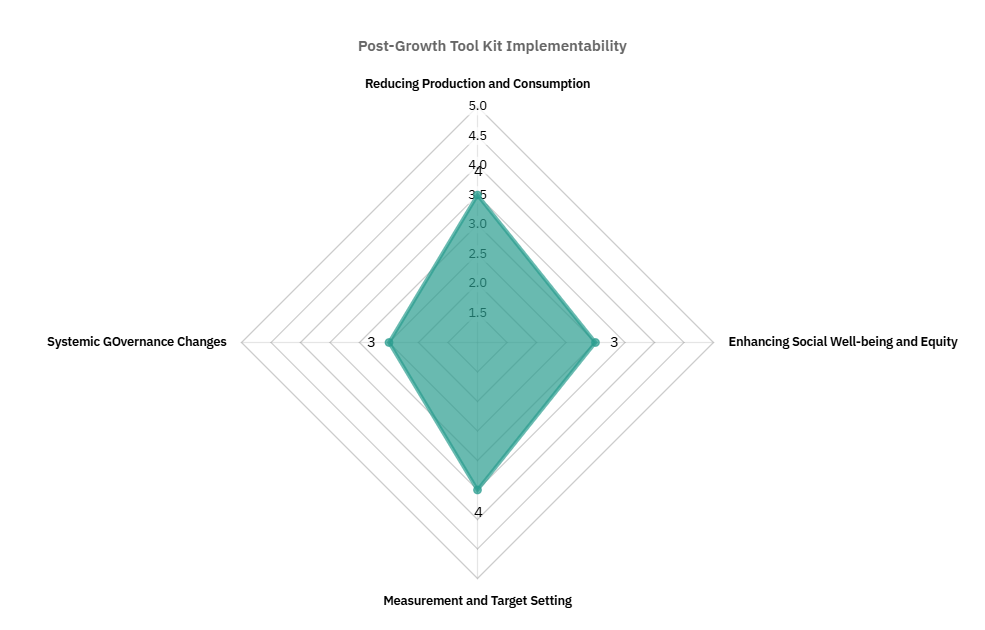
Overall Toolkit Grade: C (3.3/5.0) The degrowth agenda faces significant challenges but contains several implementable elements when framed around investment, efficiency, and improved urban living.
Toolkit 2: Enhancing Social Well-being & Equity
Universal Basic Income or Carbon Dividends (3.0/5.0 - Grade C) These policies provide direct cash payments to citizens, either unconditionally or funded by carbon pricing. They receive a moderate implementability score because while they have intuitive appeal and successful pilots, they face resistance based on cost concerns and work ethic arguments. However, the COVID-19 stimulus payments demonstrated the feasibility of direct cash transfers at scale. (The Case for Degrowth, Decoupling Debunked)
Strengthening the Commons & Social Economy (3.0/5.0 - Grade C) This includes supporting cooperatives, community land trusts, and public facilities for collective use. It receives a moderate score because these models already exist successfully in many communities but scaling them nationally would require significant cultural and legal shifts. However, their proven benefits make them a promising avenue for building alternative economic models.
Reducing Working Hours Without Pay Loss (2.5/5.0 - Grade D+) This policy proposes shorter workweeks or workdays without reducing wages. It receives a low-moderate score because despite worker popularity, employer resistance is strong, and implementation would require significant labor market restructuring. However, successful examples in countries like Iceland show potential pathways. (The Case for Degrowth)
Robust Public Services (4.0/5.0 - Grade B) This means expanded healthcare, education, childcare, and elder care provided as public goods. Its high implementability score reflects widespread support for these services in many countries and their proven ability to improve well-being while reducing private consumption. Even in the U.S., where resistance is stronger, significant portions of the public support expanded services. (Accelerationism and De-Growth)
Overall Toolkit Grade: C (3.1/5.0) Social well-being policies show moderate implementability, with public services offering the most promising avenue for near-term progress.
Toolkit 3: Measurement & Target Setting
Adopting the Doughnut Framework (3.5/5.0 - Grade C+) This means using the Doughnut's social-ecological boundaries as planning tools for cities, regions, and nations. It receives a moderate-high score because it's already being adopted by cities like Amsterdam and organizations like C40, proving its practical value. However, national-level adoption faces institutional inertia and resistance to rethinking economic goals. (Savini, Post Growth)
Replacing GDP with Well-being Indicators (3.0/5.0 - Grade C) This involves shifting government focus from GDP growth to measures of ecological health and human flourishing. It receives a moderate score because while theoretically sound and gaining traction in places like New Zealand, Scotland, and Iceland, it faces resistance from economic orthodoxy and financial markets that remain focused on traditional growth metrics. (Savini, Post Growth)
Overall Toolkit Grade: C+ (3.3/5.0) Measurement tools offer important symbolic and practical benefits with moderate implementation challenges.
Toolkit 4: Systemic & Governance Changes
Democratizing Control Over Technology (2.5/5.0 - Grade D+) This includes public direction of research priorities, technology assessment, and limitations on corporate power in tech development. It receives a low-moderate score because it challenges powerful corporate interests and techno-optimism narratives. However, growing concern about tech monopolies and AI risks is creating new openings for democratic oversight. (Accelerationism and De-Growth)
Participatory Governance (3.5/5.0 - Grade C+) This encompasses citizens' assemblies, participatory budgeting, and community decision-making. It receives a moderate-high score because these methods have proven successful at local levels and appeal to democratic values across the political spectrum. Scaling these approaches remains challenging but feasible with institutional support. (The Case for Degrowth)
Challenging the Ideology of Growth (2.5/5.0 - Grade D+) This means education, media, and cultural work to shift societal values away from growth fixation. It receives a low-moderate score because changing deeply held cultural values is slow and difficult. However, young people's growing concern about climate change suggests generational shifts may be occurring. (Accelerationism and De-Growth)
Overall Toolkit Grade: C- (2.8/5.0) Systemic changes face significant challenges but are foundational for long-term transformation.
Grading of Toolkits as a Whole:
Finding the Sweet Spot Through Strategic Policy Pairing
Our radar chart reveals a critical dilemma: policies currently fall into two camps—those with high implementability but limited efficacy, and those with high efficacy but limited implementability. Neither category alone will create the transformation needed to stay within planetary boundaries while ensuring social wellbeing.
The sweet spot lies not in choosing between these extremes, but in strategic pairing of complementary policies. When "building" policies (like green investment and public services) are explicitly linked with more restrictive but necessary measures (like reducing harmful production), they can create a balanced approach that's both implementable and effective.
For example, substantial investment in public transportation becomes more politically viable when paired with gradual reduction of parking spaces and car infrastructure. Robust public healthcare makes working hour reduction more feasible. Resource efficiency regulations gain traction when matched with support for community repair initiatives.
These pairings allow the more politically palatable "building" policies to create constituencies and momentum for the more challenging but necessary "restrictive" policies. They acknowledge that implementation and efficacy must be balanced—we cannot sacrifice one for the other if we hope to achieve the post-growth vision reflected in the Doughnut framework.
The path forward requires this careful orchestration of policy combinations that can collectively occupy the sweet spot between implementability and efficacy. By designing these strategic pairings, we can move beyond the current impasse and create momentum for meaningful transformation that respects both political realities and ecological necessities.